Every Sunday I go to a coffee shop in Japantown with my laptop to write. And I write! I have no trouble writing. The writing isn’t the problem. The problem is that when I’m done, I look at what I just wrote and think this is definitely not good enough to publish.
This didn’t use to happen. A few years ago I used to publish all the time. I’d write something, feel pretty good about it, and then hit publish without a second thought. I knew nobody really cared about what I was writing, so it didn’t matter if it sucked. And honestly, a lot of what I wrote really did suck. But I published it anyway. And yet I’d somehow occasionally write a good post.
Fast forward to today: I have no trouble writing, but I've now developed this fear of hitting publish. I’m older and objectively a better writer, with supposedly better ideas. So where did things go wrong? Why’s it so much harder to share my ideas now?
1.
There’s this unfortunate pattern that happens when someone wins a Nobel Prize. They tend to stop doing great work. Richard Hamming talks about this in You and Your Research:
When you are famous it is hard to work on small problems. This is what did Shannon in. After information theory, what do you do for an encore? The great scientists often make this error. They fail to continue to plant the little acorns from which the mighty oak trees grow. They try to get the big thing right off. And that isn't the way things go. So that is another reason why you find that when you get early recognition it seems to sterilize you. In fact I will give you my favorite quotation of many years. The Institute for Advanced Study in Princeton, in my opinion, has ruined more good scientists than any institution has created, judged by what they did before they came and judged by what they did after. Not that they weren't good afterwards, but they were superb before they got there and were only good afterwards.
Before the Nobel Prize, nobody really cares who you are. But after the Nobel Prize, you're a Nobel Prize winner, and Nobel Prize winners are supposed to have Good Ideas. Every idea, every paper, every talk at a conference is now being evaluated against the standard of your Nobel Prize-winning work. Everyone is asking, “is this worthy of a Nobel laureate?” It’s a high bar to clear. So instead of trying and occasionally failing, they just... stop trying. The fear of making something bad is worse than producing nothing at all.¹
2.
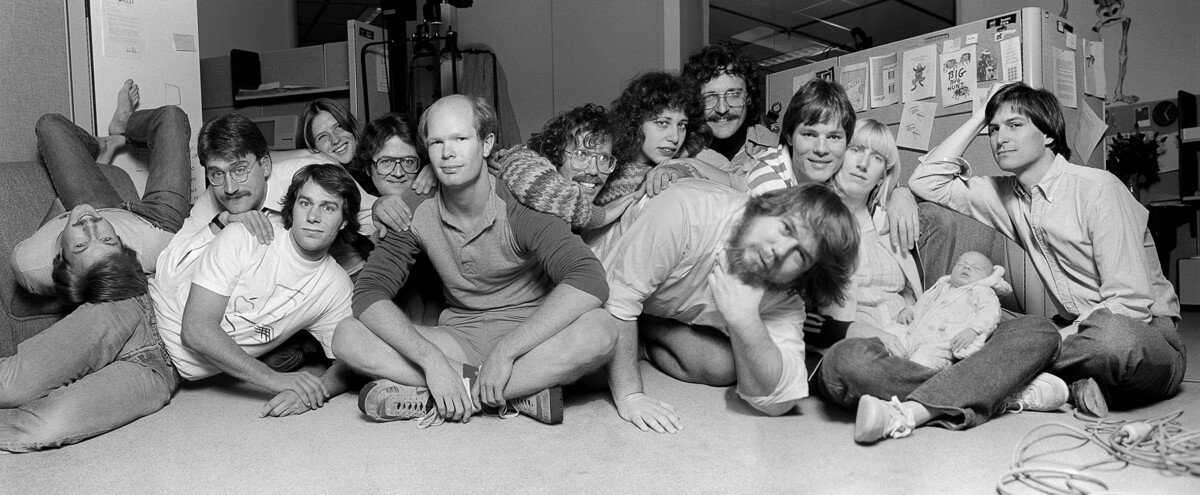
Many good ideas come from young and unproven people. The Macintosh team’s average age was 21. Most researchers at Xerox PARC were under 30. Some of the best research work I’ve seen at OpenAI has come from surprisingly young people. I don’t think young people are smarter than old people. I don’t think they work that much harder either. It mostly just seems that nobody really expects much of young people, so they're free to follow their curiosity into weird, silly, and seemingly-bad-but-actually-good ideas. They're not afraid of looking stupid. Good Ideas, and I mean this in the broadest sense – research directions, startup ideas, premises for a novel – almost always sound stupid at first. They often make the person who came up with them look stupid. So if a truly Good Idea always starts out by looking unserious, then the only way to have one is to get comfortable producing stupid things.
3.
A few weeks ago my friend Aadil and I were at Whole Foods buying a birthday cake for a friend. We wanted to write something clever on the cake but couldn’t really think of anything. We stood around thinking for a few minutes before Aadil said "Let's just say a bunch of bad ideas out loud so we can get to the good ones." And it worked! We all said a bunch of terrible ideas, and eventually we landed on a good one – a pretty clever pun based on our friend’s longtime email address.
This sounds silly, but I think it captures the entire creative process well. You start by coming up with bad ideas. You will probably look stupid. That’s inevitable. But once you’re comfortable looking stupid, you can produce the bad ideas which will eventually lead to the good ones. If you don’t have the courage to look stupid, you’ll never reap the reward of having good ideas.
It feels like there's something like a conservation law at work here: the amount of stupidity you're willing to tolerate is directly proportional to the quality of ideas you'll eventually produce. I'll call this Aadil’s Law.
4.
Yesterday, I visited the Monterey Bay Aquarium and could not stop thinking about the jellyfish exhibit. They are seriously weird creatures. Jellyfish have no bones, brains, teeth, or blood. Some are bioluminescent for reasons we don’t fully understand. They’re pretty much sacs of jelly contained within a thin membrane, drifting aimlessly at the mercy of ocean currents. Yet somehow, jellyfish have been around for over 500 million years. So by most definitions of evolutionary success, jellyfish are a great idea.
But how was evolution able to get to the jellyfish? The evolutionary process is pretty simple: generate a ton of random mutations and then let natural selection filter them. The overwhelming majority of mutations end up being harmful or neutral. An exceedingly small fraction are beneficial. If you could somehow give evolution a sense of embarrassment, so if every time it produced a fish with no fins or a bird with no wings, it felt a deep sense of shame and promised to be more careful next time – evolution would no longer work. It needs to be able to explore the fitness landscape with bad traits in order to produce good traits, and this exploration requires a willingness to produce unfit organisms. The only way evolution could get to the jellyfish was by being willing to produce the countless jellyfish-adjacent organisms which went extinct.
5.
There might be a good reason why smart people want to avoid looking stupid. I’ve spent a long time thinking about what this reason could be. The only plausible explanation is that our egos are fragile, and by not sharing any work at all, we never have to risk our egos being damaged. If we never share anything, then nothing bad can ever happen to us. But the flip side to protecting our egos is that we never end up making anything worthwhile.
I think there are two very different failure modes here, each at an opposite end of the spectrum:
- Overshare, but look stupid: You have lots of ideas, and you share them indiscriminately. You look stupid because you don’t really care about what you share, and people eventually learn to tune you out.
- Undershare, but never do anything interesting: You have lots of ideas, but share almost none of them. You’re afraid of looking stupid, so the exceedingly few ideas that you do share end up being incredibly bland. You never look stupid, but this comes at the expense of never doing anything interesting ever again.
Knowing myself, I’m definitely more at risk of undersharing my work. I’d also bet that the most people reading this blog post are prone to undersharing as well.
6.
So where do we go from here? I think the answer is actually in that Whole Foods story. Aadil's implicit goal was to “think of something clever to write on this cake" but none of us could do it because cleverness was the standard and none of our ideas met it. But when Aadil said "Let's just say a bunch of bad ideas," he changed the frame entirely. We were now playing a game where the only way to lose was by saying nothing at all.
I think that’s the key here. Your goal shouldn’t be to share something good. It should just be to share something at all. Even if it isn’t good. A half-baked blog post. A silly demo. A weird project. I’ve been doing too much selection, and not enough production.
7.
I keep thinking about the version of me from a few years ago. He was worse at almost everything. Worse writer, worse thinker, worse at making things. Nobody really knew him and nobody really cared what he had to say. And yet he had so much more courage. He’d write something in an afternoon and publish it that evening and go to bed feeling good about himself. He wasn’t performing for anyone. He was just a guy with a blog, putting his thoughts out into the world, mostly for himself. I miss that guy.
Evolution didn’t get to the jellyfish by being careful. Aadil didn’t come up with a good cake idea by trying to be clever. I think it's just about overcoming fear. Not a matter of talent, taste, or intelligence.
Just this: are you willing to look stupid today? That’s it. That’s all there is to it.
Footnotes
¹ My favorite counterexample to this is that Alec Radford (the researcher behind GPT-1) is still writing papers on cleaning pretraining data, arguably the most unglamorous thing you could work on in ML research in 2026.